

Introduction
Understanding the Township Market – Beyond the Stereotypes
The Structural Challenge Facing Township Retailers
Where EST Fits into the Township Growth Story
Township Retail – A Multi-Sector Opportunity
Insights from the EST Supplier Breakfast 2025
The Economic Case for Township Retail Alignment
Building Credibility in Township Business
What Joining EST Means in Practical Terms
FAQs
South Africa’s economic story is increasingly written in its townships. From Soweto to Mdantsane, Umlazi to Khayelitsha, these densely populated hubs are no longer peripheral markets, they are primary growth engines.
According to Statista, the majority of South Africans live in urban areas, with continued migration toward metropolitan and peri-urban nodes. Urbanisation now exceeds 68% and continues to rise:
In 2023, over 68.82 percent of South Africa’s total population lived in urban areas and cities. Urbanization defines the share of urban population from the total population of a country. ~ Statista
At the same time, research by Standard Bank South Africa shows strong levels of informal and semi-formal retail participation in lower-income communities, with micro and small enterprises forming the backbone of township commerce:
Recent estimates suggest that the township economy is valued at over R900 billion annually, underscoring its significance as a dynamic and underleveraged segment of South Africa’s economic landscape. ~ Standard Bank – Township Informal Economy Report
Layer this with data from Trade & Industrial Policy Strategies (TIPS) and township economy reports estimating the township economy to be worth hundreds of billions of rand annually
The opportunity is undeniable.
And within this environment, Elite Star Trading (EST) occupies a unique position: a voluntary buying group with members operating both inside township economies and from surrounding urban hubs supplying into them.
For entrepreneurs building spaza shops, general dealers, hardware stores, or FMCG outlets in townships – or those scaling from informal to formal retail – the question is no longer whether opportunity exists. It’s how to access structure, buying power, and long-term sustainability.
That’s where EST becomes relevant.
Understanding the Township Market – Beyond the Stereotypes
A Consumer Base That Is Economically Active
Townships are often incorrectly framed as low-income, low-margin spaces. In reality, they are:
- High-density population zones
- High cash-flow frequency areas
- Relationship-driven retail environments
- Strongly community-based trading ecosystems
Stats SA household expenditure surveys consistently show that food and fast-moving consumer goods (FMCG) remain among the largest spending categories in lower to middle-income households:
Poor households spend on average R8 485 per annum on food, which accounts for roughly 34% of their total household expenditure. This contrasts sharply with non-poor households, who spend R14 020 on average per annum on food. This only constitutes 10% of their total household expenditure. ~ StatsSA
This matters because FMCG retail thrives on volume, turnover, and community trust – three characteristics that township economies naturally provide.
The Structural Challenge Facing Township Retailers
Township entrepreneurs often face:
- Limited buying power
- Higher per-unit stock costs
- Cash flow volatility
- Supplier inconsistency
- Lack of marketing support
- Limited access to credit facilities
Without collective bargaining power, independent retailers pay more per case, per pallet, per delivery. Margins shrink quickly.
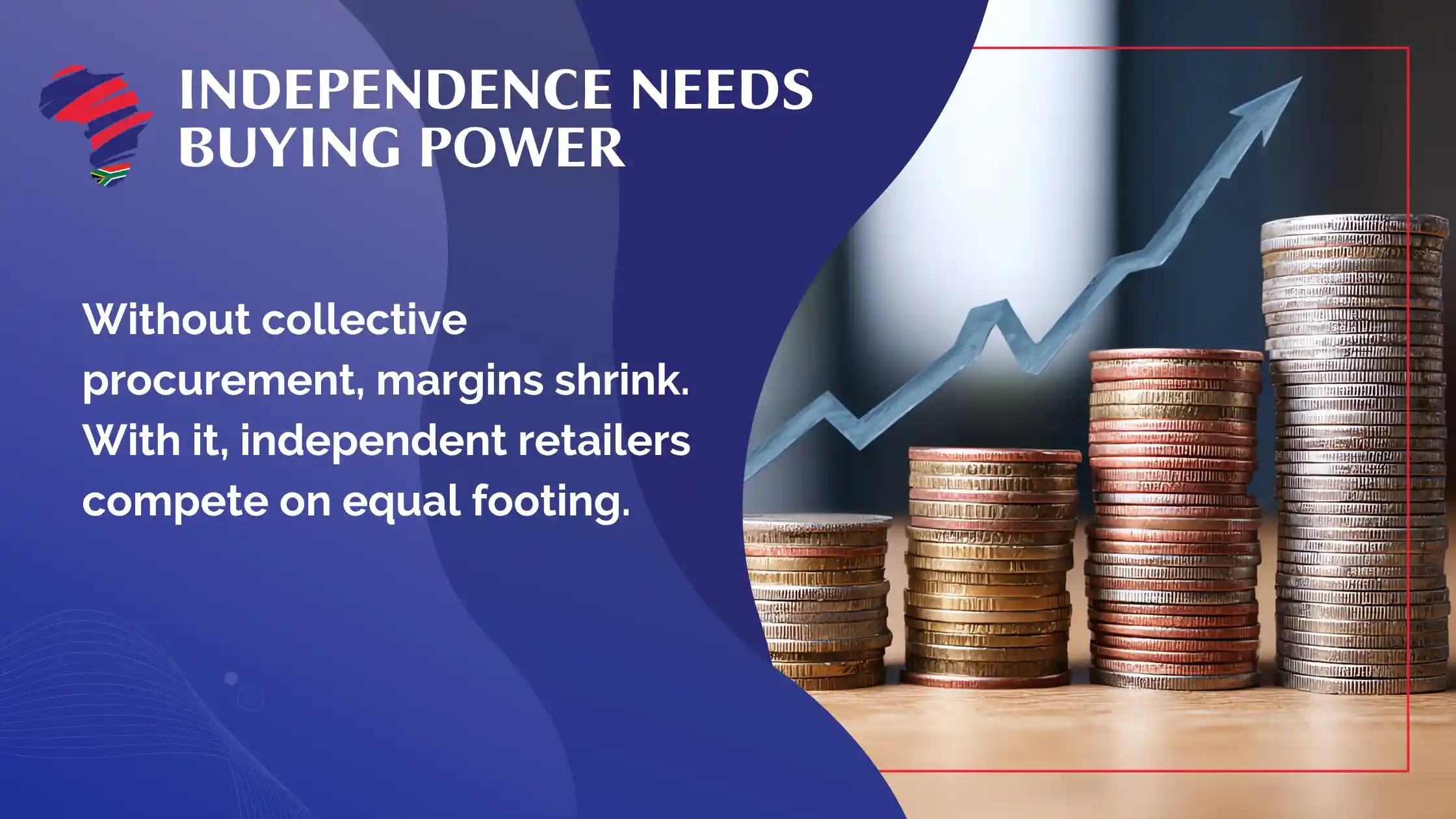
In a high-turnover FMCG environment, a 2–5% margin improvement can determine survival.
Where EST Fits into the Township Growth Story
Collective Buying Power
EST is one of Southern Africa’s largest voluntary buying groups. Its core advantage is simple but powerful:
Members buy better because they buy together.
This translates into:
- Improved supplier pricing
- Negotiated deals
- Better rebate structures
- Structured supplier relationships
For township-based retailers, this means parity with larger chains without losing independence.
Independence Without Isolation
Unlike corporate franchises, EST does not remove ownership control.
Township entrepreneurs retain:
- Their brand identity
- Their local supplier relationships
- Their pricing discretion
But they gain:
- Access to national suppliers
- Buying power leverage
- Negotiated trading terms
- Industry intelligence
This hybrid model works especially well in township contexts where community trust is everything.
Township Retail – A Multi-Sector Opportunity
EST’s relevance is not limited to one type of store.
Spaza Shops Scaling Up
Many spaza operators are evolving into mini-supermarkets. Their challenges include:
- Inconsistent supplier access
- Limited SKU range
- Stock price volatility
Joining a buying group helps stabilise pricing and improve product access.
FMCG & General Dealers
Township general dealers serve as anchor stores within communities. With structured buying power, they can:
- Increase range
- Improve margin control
- Compete with larger mall-based retailers
Hardware & Building Materials
Township infrastructure development remains strong, driven by:
- Residential improvements
- Backyard rentals
- RDP extensions
- Small contractor activity
Trade & Industrial Policy Strategies have repeatedly noted the growth of small-scale construction and informal sector linkages
https://www.tips.org.za/
Hardware stores inside township economies benefit from:
- Reliable stock availability
- Improved supplier rebates
- Structured procurement
EST membership strengthens that foundation.
Insights from the EST Supplier Breakfast 2025
At the recent EST Year-End Supplier Breakfast, industry leaders highlighted the importance of:
- Stability in volatile markets
- Long-term supplier partnerships
- Structured collaboration
- Data-led trading decisions
One key theme emerging from the breakfast was that independent retailers who align themselves strategically, rather than operate in isolation, outperform over time.
This insight is particularly relevant in township economies where scale can be achieved quickly but sustainability requires structure.
The Economic Case for Township Retail Alignment
Margin Protection in a Price-Sensitive Market
Township consumers are price-aware. Competition is tight. Stock price changes travel fast via word of mouth.
Access to improved procurement pricing through a buying group allows retailers to:
- Offer competitive shelf prices
- Maintain margin
- Absorb inflationary shocks
Stats SA inflation data shows ongoing price pressures in food categories
Without collective negotiation power, independent stores carry disproportionate inflation risk.
Supply Chain Stability
Disruptions in fuel prices, logistics, and load shedding have exposed weak supply chains.
EST’s structured supplier relationships reduce unpredictability.
In township markets, where transport costs per unit are often higher, this stability becomes a strategic advantage.
Building Credibility in Township Business
Joining EST signals:
- Professional alignment
- Structured trading
- Supplier confidence
- Growth intent
For township entrepreneurs transitioning from informal to formal operations, this credibility matters when:
- Negotiating supplier accounts
- Applying for business financing
- Engaging community stakeholders
What Joining EST Means in Practical Terms
Entrepreneurs typically gain:
- Access to negotiated supplier deals
- Improved trading terms
- Industry networking
- Market intelligence
Enquiries can be directed to:
Tel: +27 11 383 1900
Email: info@estafrica.co.za
https://estafrica.co.za/contact-us/
The Township Economy Is Not Emerging – It Is Established
The narrative that township retail is “developing” understates its maturity.
It is:
- Cash-driven
- Community-centred
- High frequency
- Relationship-based
- Resilient
The entrepreneurs operating there are not starting from scratch. They are expanding.
The difference between survival and scale often lies in procurement structure.
EST does not replace entrepreneurial instinct. It strengthens it.
South Africa’s township economy is one of its most powerful commercial ecosystems. The density, demand, and entrepreneurial energy are already present.
What many independent retailers lack is not ambition, it’s collective leverage.
EST provides that leverage.
For township-based retailers or urban suppliers servicing township markets, structured alignment can mean:
- Stronger margins
- Better stock consistency
- Improved supplier relationships
- Long-term sustainability
In a market where scale is local and competition is immediate, strategic alignment becomes more than an option. It becomes a growth strategy.
FAQs
- What is EST?
Elite Star Trading (EST) is a voluntary buying group that negotiates improved trading terms with suppliers for independent retailers.
- Can township-based retailers join EST?
Yes, subject to membership criteria and approval.
- Does EST only serve urban stores?
No. Members operate both inside township economies and from surrounding urban hubs supplying into them.
- What types of businesses benefit most from EST?
Spaza shops scaling up, general dealers, FMCG retailers, hardware stores, and building material suppliers.
- How does collective buying improve margins?
Bulk negotiation allows improved pricing, rebates, and trading terms compared to independent buying.
- Is township retail profitable?
Research from Stats SA, FinScope, and TIPS indicates strong consumer expenditure and high trading activity in township markets.
- Does EST provide financing?
Membership benefits relate primarily to buying power and supplier negotiation.
- How do I apply to join EST?
Contact EST directly via Tel +27 11 383 1900 or Email info@estafrica.co.za.
- Does joining EST remove store independence?
No. Members retain ownership and operational control.
- Why is structured buying important in townships?
High price sensitivity and supply chain volatility make margin protection essential.